

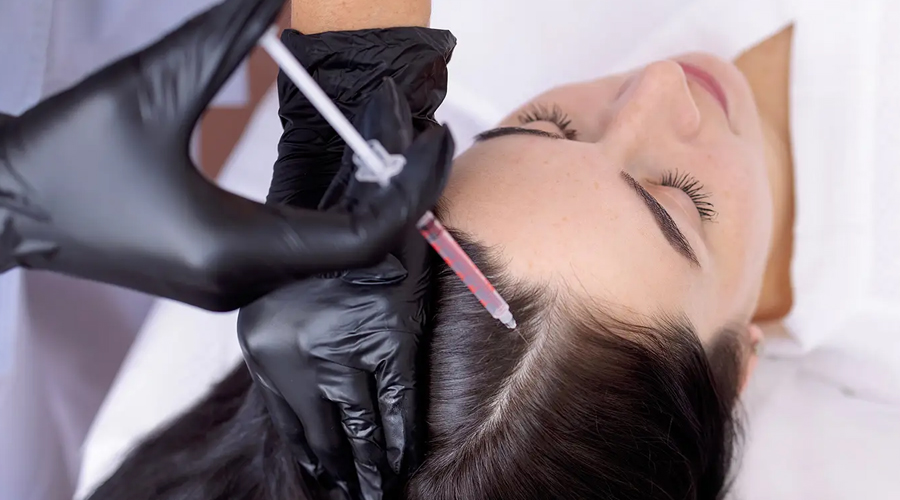
PRP (Platelet-Rich Plasma) for Hair
Platelet-Rich Plasma (PRP) therapy for hair is an evidence-supported, regenerative treatment that uses the patient's own blood to stimulate hair follicle activity and promote natural hair regrowth. It is used as an effective adjunct treatment for androgenetic alopecia, diffuse hair thinning, and alopecia areata, helping to reduce hair fall and improve hair density over a series of sessions.
How PRP Therapy Works
A small amount of the patient's blood is drawn and processed in a centrifuge to separate and concentrate the platelet-rich plasma fraction. This PRP is rich in growth factors — including platelet-derived growth factor (PDGF), vascular endothelial growth factor (VEGF), and transforming growth factor (TGF) — that stimulate follicular stem cells, improve blood supply to the scalp, and extend the anagen (growth) phase of the hair cycle.
The concentrated PRP is then injected into the scalp at the level of the hair follicles across the areas of concern. As the treatment uses the patient's own biological material, the risk of allergic reaction is minimal.
Conditions Treated with PRP for Hair
Androgenetic alopecia (male and female pattern hair loss).
Diffuse hair thinning and telogen effluvium.
Alopecia areata (as an adjunct treatment).
Post-partum hair loss.
Hair loss associated with nutritional recovery.
The Treatment Process
1. Blood Collection & Processing
A small volume of blood (typically 10–20 ml) is drawn from the patient's arm and centrifuged using a validated protocol to separate the platelet-rich plasma layer. The PRP is then activated and prepared for injection.
2. Scalp Injection
After applying a topical numbing cream, the PRP is injected into the scalp using fine needles in a grid pattern across the treatment area. The session typically takes 30–60 minutes. GFC (Growth Factor Concentrate) is a refined variation of PRP that provides a higher concentration of growth factors and is offered as an upgrade for suitable candidates.
3. Post-Treatment Care
Mild tenderness, swelling, or redness of the scalp may occur for 24–48 hours post-procedure. Patients are advised to avoid washing the scalp for 24 hours, to refrain from intense sun exposure, and to continue any prescribed topical or oral hair loss medications.
Benefits of PRP Therapy for Hair
Uses the patient's own blood — autologous and biocompatible.
Stimulates dormant follicles and extends the hair growth phase.
Reduces hair fall and improves hair density over a course of treatment.
Can be combined with medical therapy and other procedures for enhanced results.
Minimal downtime with a well-tolerated in-clinic procedure.
What to Expect
A standard PRP course involves 3–4 sessions spaced 4 weeks apart, followed by maintenance sessions every 3–6 months. Visible reduction in shedding is often noticed after the first 2–3 sessions. Improvement in hair density is typically observed over 3–6 months. PRP is most effective when initiated early in the hair loss process and used consistently alongside appropriate medical treatment.