

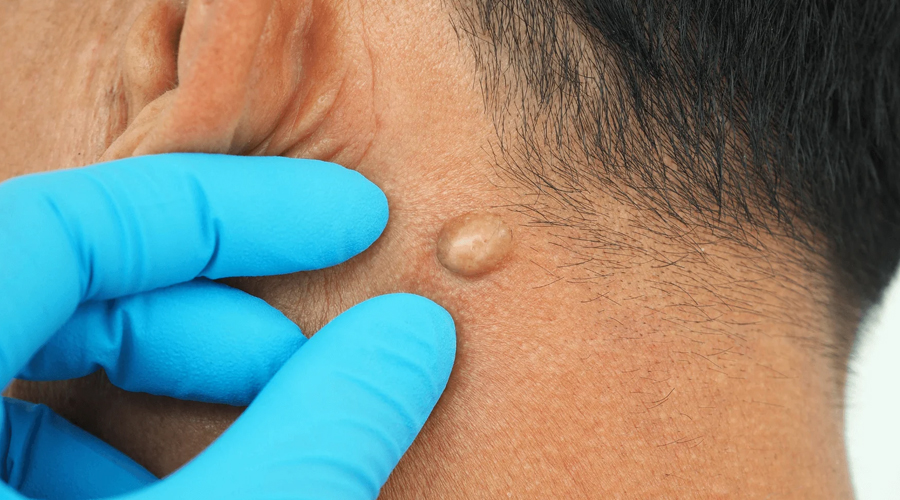
Cyst & Lipoma Excision
Cysts and lipomas are among the most common benign soft tissue lumps found on and beneath the skin. While generally not harmful, they may cause discomfort, become infected, grow in size, or be cosmetically bothersome. Surgical excision under local anaesthesia is the definitive treatment for both, with excellent outcomes when performed by an experienced dermatological surgeon.
Epidermoid Cysts (Sebaceous Cysts)
Epidermoid cysts are the most common type of skin cyst. They develop from the infundibular portion of the hair follicle and contain a thick, cheesy material (keratin). They typically present as a firm, smooth, round lump beneath the skin with a visible central punctum. Common sites include the face, scalp, neck, trunk, and back. While benign, they may enlarge over time and are prone to inflammation and secondary infection if not completely removed.
Pilar (Trichilemmal) Cysts
Pilar cysts develop from the outer root sheath of hair follicles and are found most commonly on the scalp. They have a thicker, smoother wall than epidermoid cysts and may be multiple. They are removed for cosmetic reasons or if they cause discomfort due to size or infection.
Lipomas
Lipomas are benign tumours of mature fat cells, presenting as soft, mobile, well-defined lumps beneath the skin. They are most commonly found on the trunk, shoulders, upper arms, and thighs. Most lipomas are painless, though larger or deeper ones may cause pressure symptoms. They grow slowly and are removed when they become uncomfortable, aesthetically bothersome, or when there is diagnostic uncertainty.
The Excision Procedure
1. Pre-Operative Assessment
The lump is assessed clinically to confirm its nature, size, depth, and fixity. Imaging (ultrasound) may be recommended for larger or deeper lesions. Inflamed or recently infected cysts are treated with antibiotics first; excision is performed once acute inflammation has resolved.
2. Anaesthesia & Excision
Local anaesthetic is injected around the lesion. For cysts, an elliptical incision is made to include the skin punctum if present, and the entire cyst wall is carefully dissected free to prevent recurrence — incomplete removal of the sac leads to regrowth. For lipomas, a small incision is made over the lump, and the lipoma is bluntly dissected free from surrounding tissue.
3. Closure & Aftercare
The wound is closed in layers with absorbable sutures and surface sutures or skin closure strips. The excised specimen is sent for histopathological analysis when indicated. Sutures are removed at 7–14 days depending on the location.
Benefits of Surgical Excision
Complete removal of the cyst wall prevents recurrence.
Definitive treatment for cysts and lipomas in a single session.
Performed under local anaesthesia — no general anaesthesia required.
Histopathological examination confirms the diagnosis.
Resolves pain, discomfort, or cosmetic concerns caused by the lump.
What to Expect
Most excision procedures are completed in 20–45 minutes depending on size and location. A small linear scar at the excision site is expected — placed within skin tension lines to minimise visibility. Post-operative care including wound hygiene and sun protection supports optimal healing. Recurrence is rare when the cyst wall is completely removed. Your dermatologist will advise on the post-operative care specific to your procedure.