

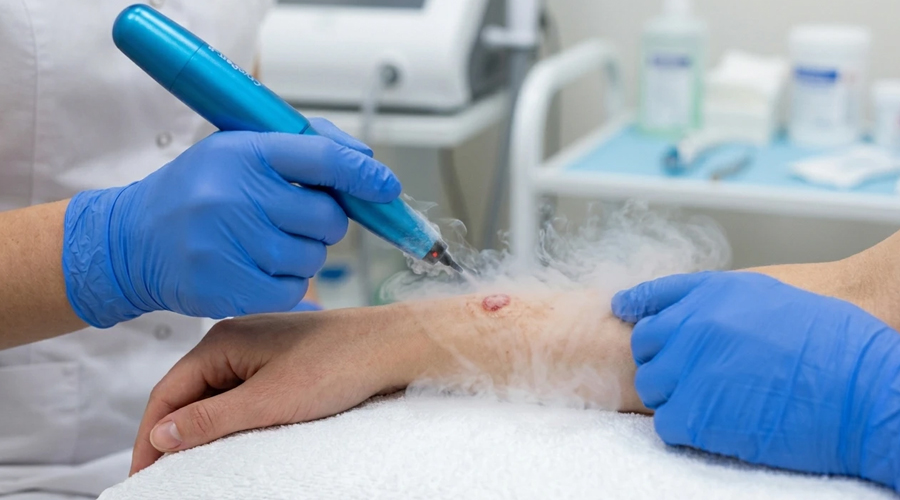
Cryotherapy
Cryotherapy in dermatology involves the application of extreme cold — most commonly using liquid nitrogen — to destroy abnormal or unwanted skin tissue. It is a well-established, effective, and widely used office procedure for treating a range of benign and pre-malignant skin lesions. The freezing process causes cellular destruction in the targeted tissue, leading to the lesion's eventual separation and healing of the underlying skin.
How Cryotherapy Works
Liquid nitrogen is applied to the skin at a temperature of approximately −196°C, either by spray or using a cotton-tipped applicator. The rapid freezing causes ice crystal formation within the cells of the lesion, disrupting cell membranes and leading to cell death. As the treated tissue thaws and refreezes (in a freeze-thaw-freeze cycle for more resistant lesions), vascular damage also occurs, cutting off the blood supply to the lesion. The damaged tissue subsequently forms a blister or scab, which separates over 1–2 weeks to reveal healing skin beneath.
Conditions Treated with Cryotherapy
Common warts (verruca vulgaris) and plantar warts — one of the most common uses.
Plane (flat) warts and filiform warts.
Molluscum contagiosum.
Seborrhoeic keratoses — benign warty growths.
Actinic keratoses — pre-malignant rough patches from sun damage.
Keloids and hypertrophic scars — in combination with intralesional injections.
Small haemangiomas and benign vascular lesions.
Solar lentigines (sun spots).
The Procedure
1. Lesion Evaluation
The lesion is clinically assessed and, where necessary, examined with dermoscopy to confirm its nature and suitability for cryotherapy. Pre-malignant or uncertain lesions may require biopsy before treatment.
2. Cryotherapy Application
Liquid nitrogen is applied to the lesion using a spray device or cotton-tipped applicator for a specific duration based on lesion type, size, and depth. A freeze time of 5–30 seconds per cycle is typical. Patients experience a cold, stinging sensation during the freeze and a throbbing discomfort for several minutes after.
3. Post-Treatment Response
Redness, swelling, and blister formation at the treated site develop within 24 hours. The blister and surrounding tissue form a scab that separates within 1–3 weeks. Darker skin types may experience temporary post-inflammatory hypopigmentation or hyperpigmentation at the treated site.
Benefits of Cryotherapy
Quick, in-clinic procedure with no incisions required.
Effective for a wide range of common skin lesions.
No anaesthesia required for superficial lesions.
Multiple lesions can be treated in a single session.
Well-established safety profile with decades of clinical use.
What to Expect
Warts and other viral lesions may require 2–4 cryotherapy sessions spaced 2–4 weeks apart for complete clearance. The treated area heals over 1–3 weeks depending on the lesion size and depth. Temporary pigmentation changes are more common in darker skin tones and usually resolve over several months. Post-procedure care instructions will be provided to support optimal healing and minimise complications.